When people are replacing their floors, scratch resistance is always near the top of the list. It's a fair concern. A floor that looks tired and marked within a couple of years is nobody's idea of a good investment.
The question of which is more scratch-resistant: laminate or vinyl doesn't have a single clean answer. Both materials hold up well under everyday use, but the way they resist damage differs, and the right choice comes down to where the floor is going and what it'll face. This guide covers the practical details you need to make that call with confidence.
Laminate is a composite product built from several bonded layers. The base is a high-density fibreboard (HDF) core, which gives it rigidity. Above that sits a photographic layer printed to mimic wood or stone, and on top of that is a hard, transparent wear layer. That wear layer is classified using an AC (Abrasion Class) rating, a European standard that runs from AC1 to AC5.
Vinyl plank, sold as LVP (luxury vinyl plank) or LVT (luxury vinyl tile), is constructed differently. The entire plank is PVC-based, with no wood fibre in the composition at all. Its protective surface is a clear wear layer measured in millimetres, typically between 0.3mm and 0.7mm for home use. Because there's no wood-based core, vinyl is inherently waterproof throughout.
These structural differences are worth understanding because they shape how each floor performs, not just against scratches, but in terms of water exposure, repair, and long-term durability.
| Feature | Laminate Flooring | Vinyl Plank (LVP / LVT) |
| Scratch Resistance | High | Good to Excellent |
| Water Resistance | Low to moderate, not waterproof | Fully waterproof throughout |
| Durability | Moderate to high | High |
| Protective Layer | AC3 (domestic) to AC5 (heavy commercial) | 0.3mm light use, 0.7mm+ heavy use |
| Repair Ease | Moderate, individual planks can be tricky to replace | Easy, click-lock planks swap out cleanly |
| Pet Friendliness | Good, hard surface holds up against claws | Good, softer surface may show deep claw marks |
| Underfoot Feel | Firm with a slightly hollow sound | Softer and quieter underfoot |
| Best Suited To | Living rooms, bedrooms, hallways | Kitchens, bathrooms, utility rooms, whole-home use |
Scratch-resistant laminate flooring gets its toughness from the AC rating applied to its wear layer. This classification is based on standardised testing covering abrasion, impact, staining, and resistance to furniture movement. It's a meaningful indicator of real-world performance, not just a marketing figure.
What the AC ratings mean in practice:
| AC Rating | Suitable For | Practical Application |
| AC1 | Very light domestic use | Low-traffic bedrooms |
| AC2 | General domestic use | Living rooms, dining rooms |
| AC3 | Heavy domestic / light commercial | All rooms including hallways, the domestic standard |
| AC4 | General commercial use | Offices, retail, busy family homes |
| AC5 | Heavy commercial use | High-footfall public spaces |
AC3 is the sensible starting point for most homes. If you have dogs or a genuinely busy household, kids, regular visitors, heavier furniture movement, AC4 is worth the modest extra cost. The difference in how the surface holds up after a few years with pets is visible.
One practical note: scratches on laminate are typically surface-level. They rarely compromise the plank structurally, but they can catch the light at certain angles. This is more noticeable on smooth high gloss finishes than on textured or embossed surfaces. If scratch visibility concerns you, opt for a textured finish. It disguises marks far more effectively, especially across detailed layouts like Herringbone.
Felt pads under furniture legs are one of the most impactful things you can do. Bare furniture feet dragged across the laminate are responsible for a large proportion of visible scratches. Keeping grit and sand off the surface matters too. Fine particles tracked in from outside act like abrasives underfoot. A regular sweep or vacuum (beater bar off) deals with this. Avoid steam mops, as the moisture eventually works its way into the joins and causes the board edges to lift.
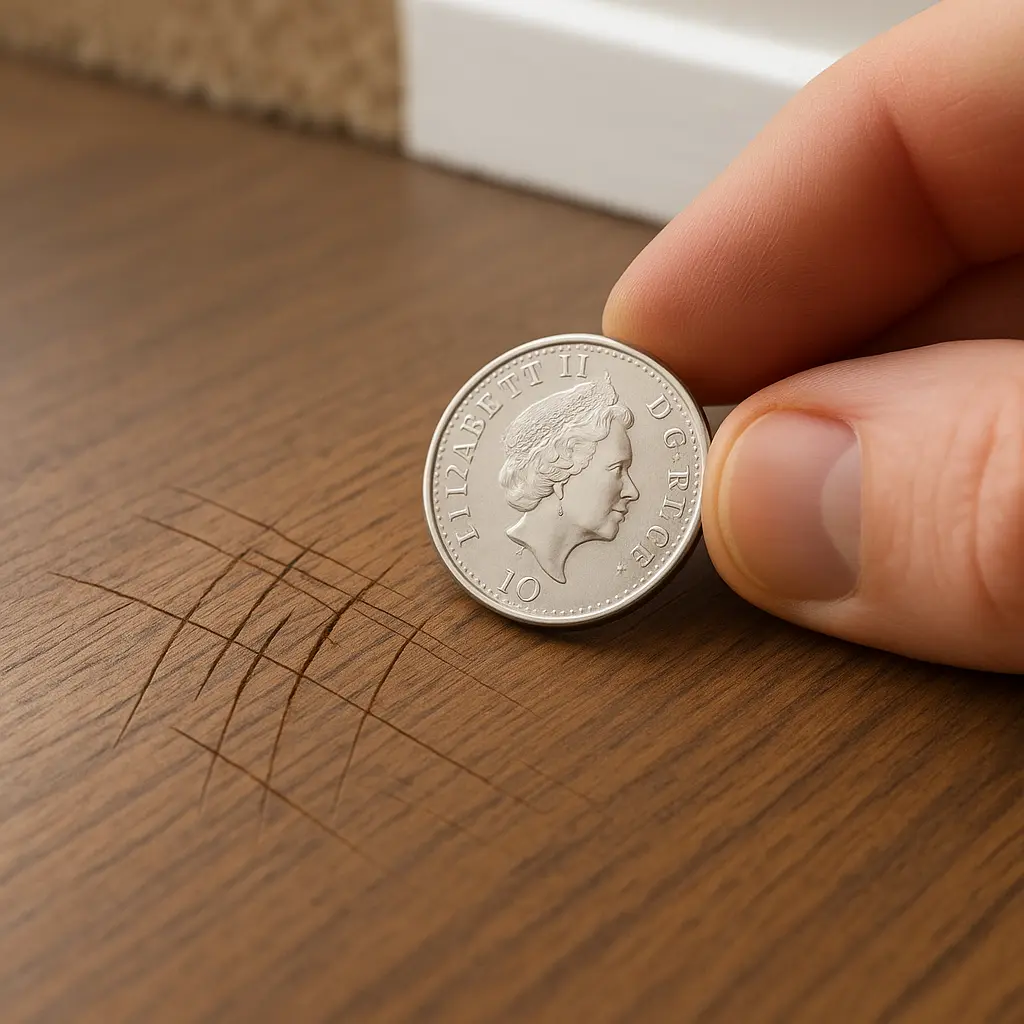
With scratch-resistant vinyl flooring, the wear layer thickness is the defining specification. It's the clear coating bonded to the top surface of every plank, and it's what you should be looking at when comparing products, not the total plank thickness, which includes the core and backing.
Wear layer guide for vinyl plank:
| Wear Layer | Best For | Realistic Lifespan in Heavy Use |
| 0.3mm (12 mil) | Light domestic use, bedrooms, studies | 3 to 7 years with regular traffic |
| 0.5mm (20 mil) | General home use including homes with pets | 7 to 12 years |
| 0.7mm (28 mil) | Heavy home use or light commercial | 12 to 20+ years |
| 1.0mm+ | Commercial and high-footfall environments | 20+ years |
For most family homes, 0.5mm is the minimum to aim for. Hallways, kitchens, and rooms with pets are better served by 0.7mm. The jump in longevity justifies the price difference. Budget vinyl at 0.3mm will hold up in low-traffic rooms but will show wear faster in busier areas.
Vinyl is slightly more flexible than laminate, which gives it one advantage: it absorbs minor impacts rather than marking. The trade-off is that sharp or very heavy objects can leave indentations in the surface that a rigid laminate board would resist. Neither floor is invincible. They just fail in different ways.
Is lvt scratch resistant is one of the more common questions we hear, and the answer is a clear yes, with the same caveats that apply to all vinyl. LVT tends to be denser and thicker than standard vinyl plank, which typically means better resistance to both scratches and dents. For kitchens, bathrooms, or any tiled application, LVT with a 0.5mm or above wear layer performs reliably under daily use.
Across general foot traffic, both floors perform similarly when matched at equivalent quality levels. The differences emerge in specific situations:
Pet claws: Laminate at AC4 tends to handle fine scratch marks from dog nails slightly better than mid-range vinyl. Premium vinyl at 0.7mm+ closes that gap considerably. Budget vinyl at 0.3mm will show claw marks noticeably faster than either.
Moving furniture: Vinyl's slight flexibility works in its favour here. Dragging a chair or table is less likely to leave a visible mark on vinyl than on laminate, where protective pads become genuinely important.
High heels and point loads: The rigid HDF core in laminate gives it a marginal advantage on very concentrated loads like stiletto heels. Vinyl can be indented by sharp, heavy pressure.
Sand and fine grit: This is the biggest practical risk for laminate. Abrasive particles ground in underfoot degrade the wear layer steadily. Regular cleaning matters for both floors, but it's especially important for laminate near entrances and hallways.
In a well-maintained home, a quality laminate at AC4 and a quality vinyl at 0.5mm to 0.7mm are genuinely comparable in scratch resistance.
Vinyl plank is fully waterproof. The core, the surface, the joints, none of it is damaged by water sitting on it. For bathrooms, utility rooms, kitchens, or anywhere that sees regular moisture, this is a significant practical advantage.
Laminate has come a long way. Many products now carry moisture-resistant certification, and some ranges perform well with brief water exposure. But moisture-resistant and waterproof are not interchangeable. A slow leak under a dishwasher, a dog bowl that gets nudged regularly, or wet boots left on the floor can cause laminate edges to swell, and the joins to lift. When that happens, there's no straightforward fix. The affected boards need replacing.
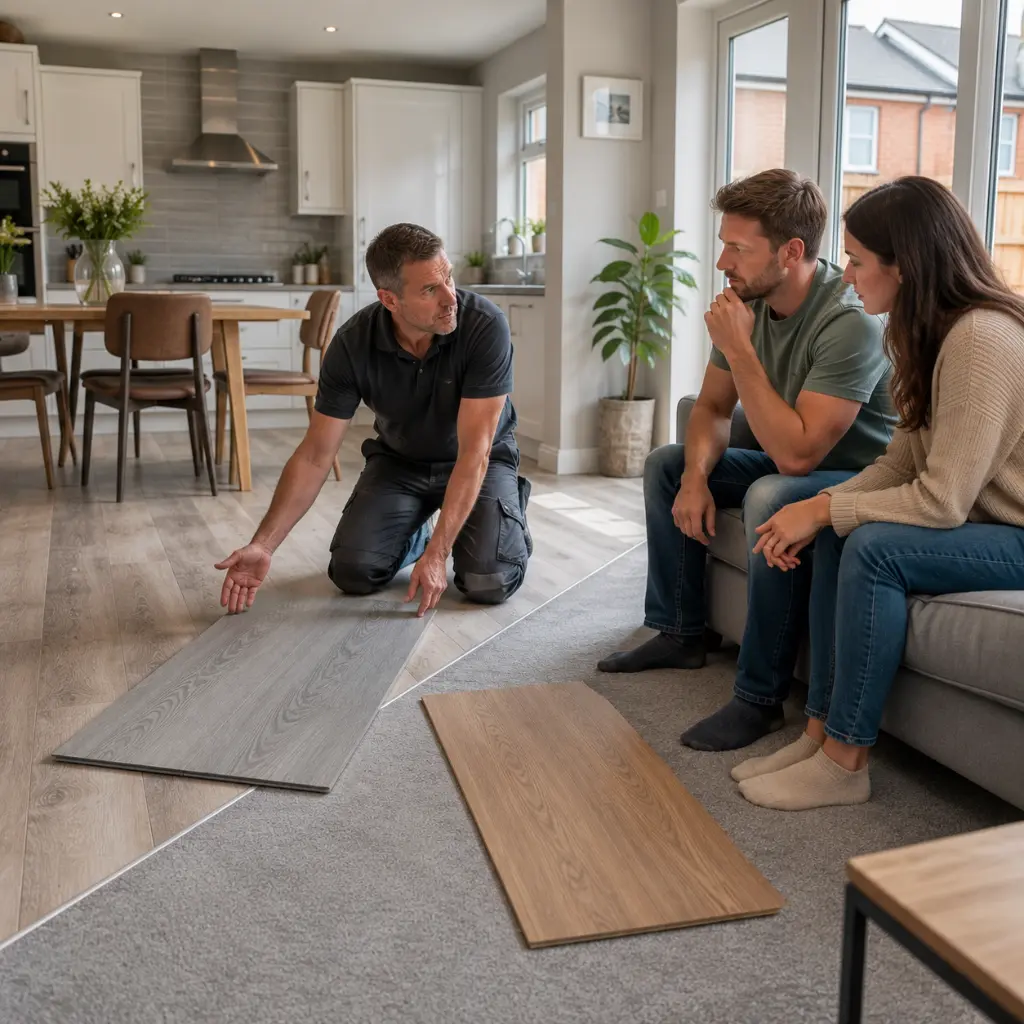
For an open-plan ground floor running from a living room through to a kitchen, vinyl plank is the pragmatic call. Running the same floor throughout removes the need for a transition strip and means you're not gambling on how the laminate handles the kitchen zone.
Does laminate flooring scratch easily?
Not when it's properly specified. AC3 handles everyday household traffic without issue. Scratches tend to appear when grit gets ground in underfoot, or when furniture is moved without pads. A textured or hand-scraped finish makes a real difference in how noticeable any marks are. High-gloss laminate shows scratches far more visibly than an embossed or distressed surface.
Is LVT scratch resistant?
Yes. LVT carries the same clear wear layer as vinyl plank, and the same thickness rules apply. Thicker means tougher. For domestic use, 0.5mm (20 mil) is a reliable baseline. LVT is generally denser than standard vinyl plank, which tends to improve its resistance to both surface scratches and denting under load.
What is the best scratch-resistant flooring for dogs?
Laminate at AC4 or vinyl at 0.5mm+ are both capable options. For dogs that pace or skid, vinyl is slightly preferable as it offers more grip and is easier on their joints. For managing fine claw marks over time, a textured laminate finish in AC4 hides the evidence better than a smooth one. Avoid budget vinyl at 0.3mm. It'll show wear faster in households with active dogs.
Is scratch proof flooring actually available?
No floor is genuinely scratch proof. The term doesn't exist in any meaningful technical standard. What scratch resistant means in practice is that the surface withstands normal daily use without showing premature wear. A quality laminate or vinyl, properly specified for the room, will stay looking good for well over a decade. Expecting complete imperviousness from any hard floor is unrealistic, but the right product makes scratches a non-issue under normal conditions.
Can scratches be repaired on laminate or vinyl?
Minor laminate scratches can often be filled with a colour-matched wax stick or repair marker, mostly invisible once done. More serious damage usually means replacing the plank, which is more involved with laminate than vinyl. With vinyl's click-lock system, a single damaged plank swaps out relatively quickly, making repair less disruptive overall.
Which is more scratch resistant — vinyl or laminate flooring — for a kitchen specifically?
For a kitchen, the waterproofing question outweighs the scratch question. Vinyl is the better choice, not because it's dramatically more scratch resistant, but because it handles water without risk. There's always moisture exposure around the sink, dishwasher, and fridge in a working kitchen, and that's where laminate becomes vulnerable, regardless of its AC rating.
Scratch resistance alone is rarely the deciding factor once you look at both floors clearly. In the scratch resistance column specifically, a well-specified laminate and a well-specified vinyl are closely matched. Where they genuinely differ is water. If the room involves moisture, vinyl plank wins. If you're fitting a dry room and want the best value alongside strong scratch resistance, quality laminate at AC4 is hard to beat.
For whole-home projects where you'd rather not think about which rooms can handle which floor, vinyl plank removes the complexity. Using one specification across every room, including a conservatory floor, avoids transitions and compromises. Get in touch today for a consultation and quote. We’ll break down the differences and help you choose the most durable option for your space.