Your hallway gets more abuse than any other room in the house. Muddy wellies, wet umbrellas, the daily chaos of school runs, that coffee spill when you're juggling keys and shopping bags. And yet it's the first thing anyone sees when they walk through your door.
The right hallway carpet ideas do two jobs at once: take the daily punishment without showing it, and make the entrance feel like somewhere you actually want to come home to. Not the staged magazine version. Something that works for real households with real mess.
In the UK, your front entrance deals with whatever the weather outside is doing. Rain, mud, wet boots. It all lands here first. Pick the wrong carpet, and you end up with patches that never dry properly, stains that seem to breed, and a faint smell that no candle quite covers.
Pick the right one and the hallway quietly does its job, muffling noise, keeping warmth in, and looking presentable without demanding constant attention. It's not a glamorous brief, but it's an important one. Your hallway takes a week's worth of traffic in a day compared to most other rooms, so the spec matters far more here than the price tag alone.
Your hallway sees more action in a week than your lounge room carpet does in months, which is why so many people end up replacing it sooner than they expected and spending money they hadn't budgeted for.
There's no single right answer. It depends on your household, your budget, and how honest you are about how much maintenance you'll actually keep up with. That said, here's how the main types compare in a hallway context:
| Carpet Type | Durability | Stain Resistance | Best For |
| Loop Pile (Berber) | Excellent | Good, hides dirt in texture | Busy households, pets, high footfall |
| Twist Pile | Very Good | Good, marks lift easily | Most UK hallways, practical and smart |
| Wool Blend | Good to Excellent | Good with treatment | Period homes, warmer feel, longer lifespan |
| Carpet Tiles | Excellent | Very Good, replace individual tiles | Rental properties, DIY, practical households |
| Stain-Treated Synthetic | Very Good | Excellent | Families with young children or dogs |
Something worth knowing before you walk into a showroom: pile density is often a better indicator of longevity than fibre type. A tightly woven synthetic will hold its shape longer than a loosely constructed wool carpet once a hallway starts throwing its worst at it. Ask about pile weight in grams per square metre. It tells you more than the material label alone.
Loop pile carpets are naturally forgiving. The looped construction disguises footprints and everyday dirt in a way that a cut pile simply can't. You can walk across it in wet shoes, and it looks roughly presentable an hour later. That built-in resilience makes it the go-to for households that live at a pace and clean up when they get the chance.
Twist pile has a cleaner, smarter look. Fibres are spun and cut to give a more finished surface underfoot. It shows scuffs more readily, but the trade-off is that marks tend to brush out more easily, too. If you're the sort of person who actually vacuums twice a week, a twist pile will reward that habit.
On the pile height question, lower is generally better for hallways. Shallower pile cleans faster, resists flattening under repeated traffic, and doesn't trap grit the way deeper textures do. Save the plush underfoot experience for somewhere it won't be walked to death inside six months.
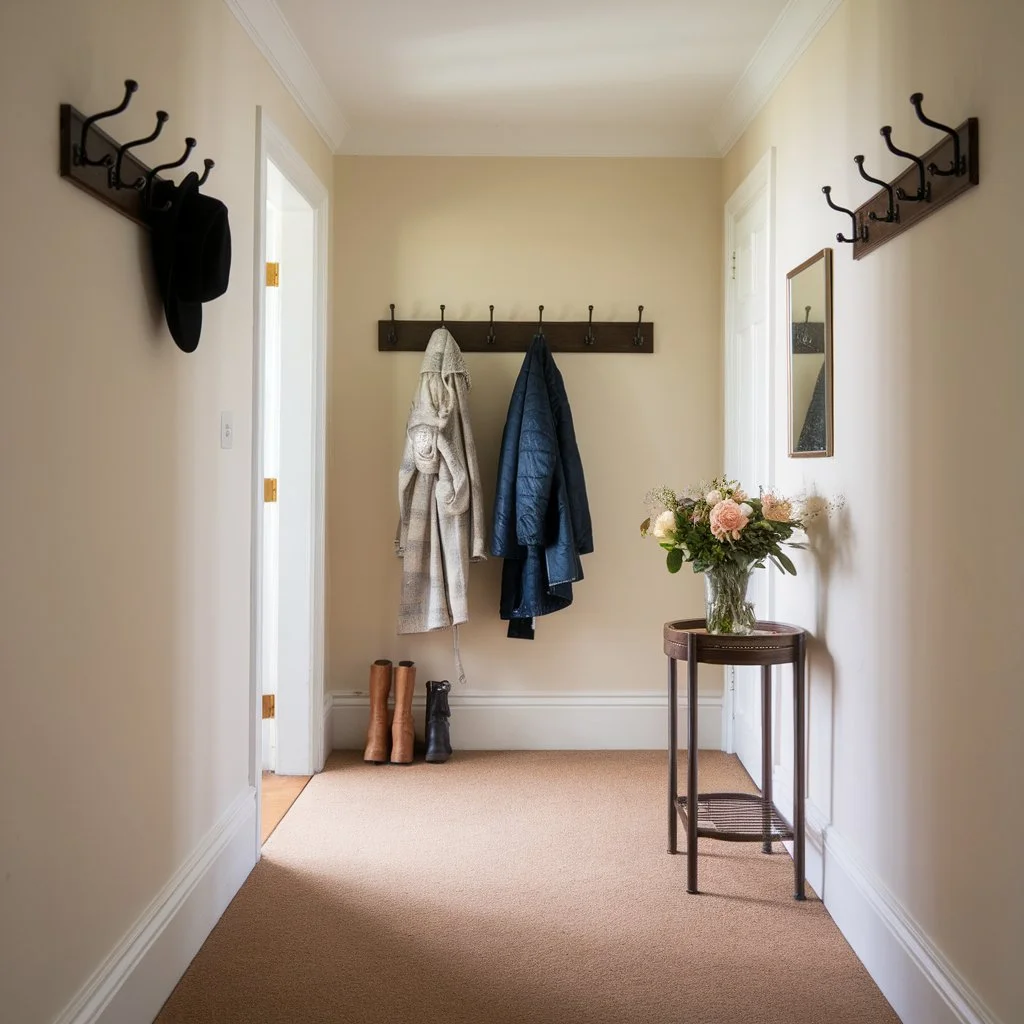
More often than people expect, yes. Carpet tiles for hallways solve a problem that full-width carpet can't: when a section wears out or takes a bad stain, you replace just that tile, not the whole floor.
In a hallway, the central path gets walked constantly, while the edges near the skirting boards barely see any traffic at all. Five years in, you might have tiles near the walls that still look almost new alongside a central strip that's been ground down daily. Swap out the worn section, and you're done. No fitter required, no disruption, and nowhere near the cost of a full replacement.
The style range has moved on considerably, too. The assumption that carpet tiles mean dull commercial grey is outdated. There are warm, domestic-looking textures and neutral tones available that sit perfectly in a home entrance. For rental properties in particular, they're one of the more sensible flooring choices going.
Contemporary carpeted hallway ideas lean toward texture over pattern and tone over statement. Subtle weaves, understated geometrics, and colours that anchor rather than shout tend to outlast bolder choices by years. Grey has held its place in UK hallways precisely because it works across so many different interiors without demanding the rest of the house adjust around it.
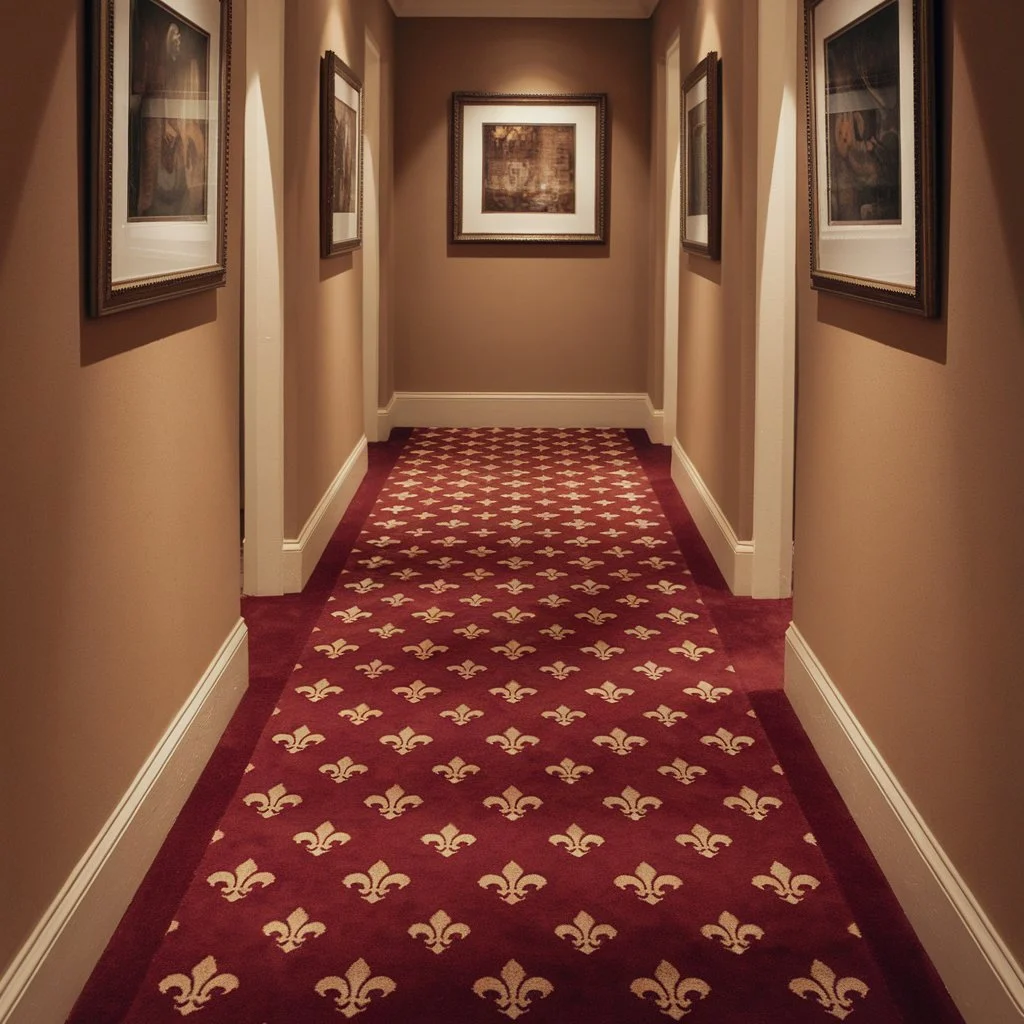
Bold patterned stair carpet can absolutely be a feature worth committing to, and Victorian terraces in particular carry it well. The question to ask yourself is whether you'll still feel the same about it in year seven. Busy florals and high-contrast designs photograph well but can become visually exhausting when you're rushing past them twice a day.
For modern hallway carpet ideas with real longevity, take your cues from the space itself. A narrow entrance needs something that opens it up. A wider hall can carry a richer, darker tone that feels considered rather than default.
Hallway carpet colour ideas split people into two camps fairly neatly. Go pale to brighten the space, or go dark to hide the daily mess. Both approaches have genuine logic behind them.
Light colours open up a narrow hallway and make it feel less like a corridor. The problem in a busy household is that the pale carpet becomes a running record of everything that's been tracked in. Scuffs, paw prints, schoolbag drag marks. It all shows. If your energy for cleaning is finite, light colours will test it.
Darker tones are forgiving of dirt but can make a hallway that already lacks natural light feel noticeably heavier. The colours that tend to work hardest are warm mid-tones, taupes, soft mushroom, dusty sage, that split the difference between brightening the space and hiding what life throws at the floor.
If your front door has glass panels, fade resistance is worth checking before you buy. A rich colour that looks striking on day one can shift noticeably within a couple of years of morning sun. It's the sort of specification detail that gets overlooked at purchase and regretted later.
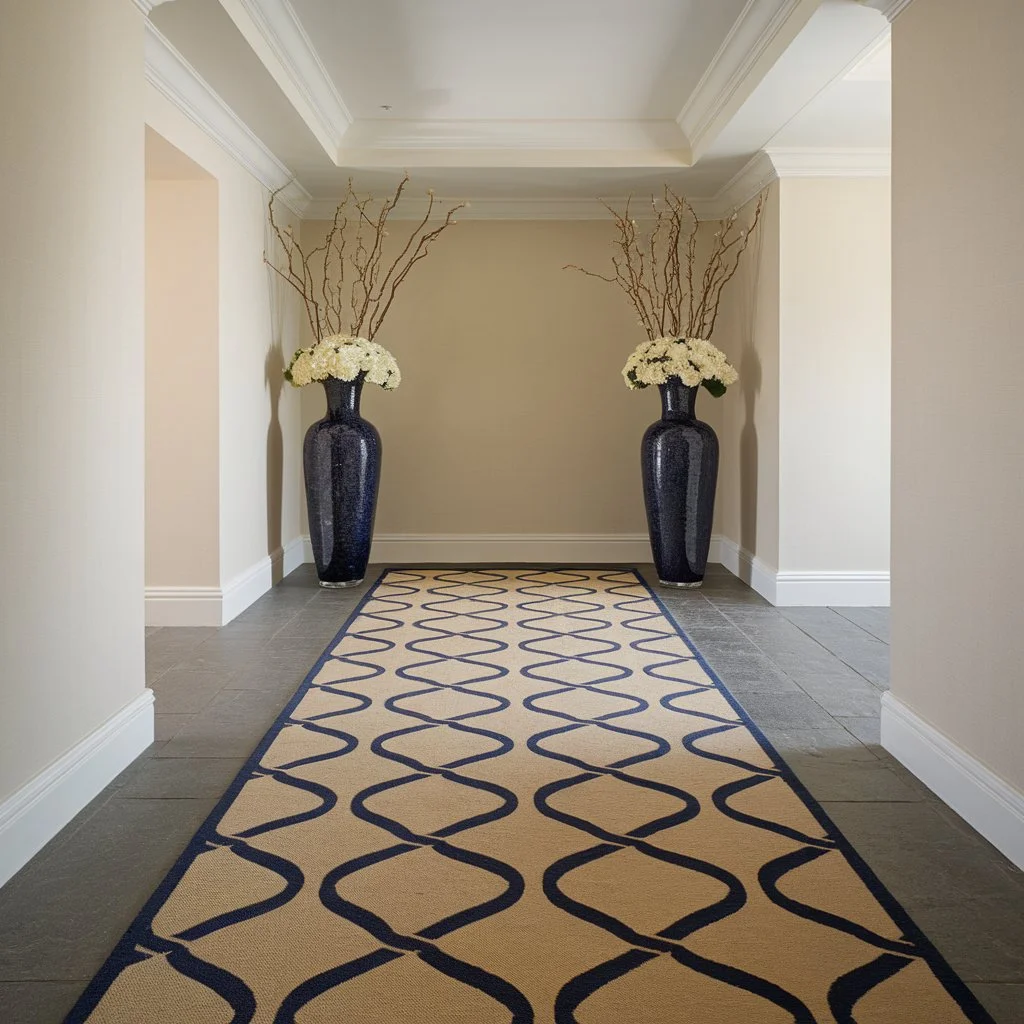
A runner is one of the most practical carpet ideas for hallways, particularly in the long, narrow layouts common in British terraced homes. Rather than covering the whole floor, a runner protects the central strip that takes all the traffic while leaving the edges of the floor visible.
Hallway carpet runner ideas work especially well where there's existing flooring worth preserving, original floorboards, tiled encaustics, or even just decent-conditioned wood that you'd rather not cover entirely. The runner takes the daily punishment, and the floor beneath stays protected. In rentals, they're ideal precisely because nothing permanent is involved.
Getting the proportions right matters. Too narrow, and it reads as an afterthought. Too wide and you lose the framing effect that gives runners their architectural appeal. For most British hallways, two-thirds of the floor width is about right.
Wool's reputation for being fussy isn't entirely unfair. Pure wool in a hallway is resilient and ages well, but it's also expensive, moisture-sensitive, and not ideally suited to a space where wet coats and dripping umbrellas are a daily reality in Britain's climate.
Wool blends are where the value proposition makes more sense for hallways. You get the natural warmth and structural longevity of wool alongside synthetic fibres that handle wear and moisture better. A quality blend in a hallway will often outlast a cheaper pure synthetic over the long term, which is where the higher upfront cost tends to pay back.
Jute and sisal are occasionally suggested as natural alternatives. They look good in the right setting and suit contemporary, minimal interiors well. The limitation in a UK hallway is moisture. Neither material tolerates damp conditions, and an entrance that regularly sees wet outerwear dropped on the floor is not where they perform best.
Wet carpet in a hallway is one of the most common flooring complaints in UK homes, and in most cases it's preventable. The usual causes are wet footwear left directly on carpet, condensation rising through an unprotected concrete subfloor, and poor ventilation in a closed entrance space.
In older properties, especially, it's worth checking whether the subfloor has a damp-proof membrane before laying new carpet. Moisture coming up from below will defeat any carpet eventually, and a moisture-barrier underlay helps manage the symptom without fixing the cause. If the subfloor is the problem, that needs to be addressed first.
Once a wet carpet in a hallway has happened, drying out the underlay is just as important as drying the surface. Underlay that stays saturated is almost always the origin of that persistent damp smell, and surface cleaning doesn't touch it. If the underlay has been significantly wet, replacing it rather than hoping it dries fully is usually the right decision.
On the prevention side: stain-treated synthetics handle moisture better than natural fibres, a good entrance mat outside the door catches most of what comes in on feet, and having a dedicated spot for wet footwear away from the carpet removes the single biggest source of the problem.
A few things that routinely trip people up and are easy to avoid:
Measure the full run, including any turn to the stairs. Forgetting the awkward angle at the bottom of the staircase or misjudging the length from door to kitchen means either a second order or a visible join in a place you'll notice every day.
Don't cut costs on the underlay. Good underlay extends carpet life, adds thermal value, and softens the floor noticeably, particularly relevant in ground-floor hallways where concrete subfloors make themselves felt underfoot. The carpet gets the attention, but underlay is often what separates a floor that lasts from one that doesn't.
Take samples home before ordering. Showroom lighting is nothing like the artificial light most UK hallways operate under. A colour that looks right under bright retail lighting can read completely differently in a dim, north-facing entrance. Test in your actual space, at different times of day.
Ask about twist count on pile carpets. Higher twist means the fibres are more tightly wound, which means better resistance to crushing and flattening on a heavily walked path. It's a more useful quality indicator than the material label alone.
Hallways are among the trickier rooms to carpet well: doorway transitions, stair nosings, pipes in inconvenient places. There are several points where an amateur job shows, and a poorly fitted carpet doesn't just look off. It creates trip hazards and wears unevenly, failing faster than the material spec would suggest.
Professional fitters have dealt with all of it before. Uneven Victorian floorboards, concrete stairs that aren't square, radiator valves positioned exactly where you don't want them. They'll also guide you on which underlay suits your specific subfloor, which matters more than most people realise when it comes to how the finished floor actually feels and lasts.
Vacuuming regularly is the single most effective thing you can do for hallway carpet, not just for how it looks, but for how long it lasts. Grit carried in on shoes works its way into the pile and abrades the fibres from underneath. A few minutes with a vacuum several times a week makes a meaningful difference to lifespan.
A washable cotton runner over the main carpet during the worst of the weather months protects the surface where traffic is heaviest. Swap it out when the mud season passes, and the carpet underneath has been spared the worst of it.
A professional steam clean every twelve to eighteen months handles the deep-seated grime that regular vacuuming leaves behind. If yours is a wool carpet, confirm the cleaner has experience with natural fibres. Saturating wool is a common error with consequences that are harder to reverse than the original dirt.
Are carpet tiles good for hallways?
Yes, particularly where practicality matters more than aesthetics. The ability to replace individual tiles rather than retiling the whole floor is a real advantage in a space that takes concentrated traffic on one narrow path. They're also straightforward to lay without professional help.
How do I stop my hallway carpet from getting wet and smelling damp?
Start outside the door with a good mat, then another just inside, and keep wet footwear off the carpet while it drips. If the smell persists despite surface drying, the underlay is usually the culprit. Once it's saturated, it needs replacing rather than just drying out. In older homes, check the subfloor for damp-proofing too.
What pile height is best for hallway carpet?
Somewhere between 5mm and 10mm is the practical range for a hallway. Lower pile cleans more easily, holds up better under concentrated foot traffic, and doesn't trap grit the way deeper textures do. Reserve a deep pile for rooms that don't take the same daily punishment.
Is wool carpet suitable for a hallway?
A wool blend works well; pure wool is harder to justify for a space that takes this much daily wear. An 80/20 wool-synthetic blend gives you the natural feel and structural longevity of wool with better moisture and wear resistance, which is a more sensible balance for a UK hallway.
How long should hallway carpet last?
Eight to twelve years is reasonable for good quality carpet laid over proper underlay and maintained regularly. Lower-quality carpet in a busy household can start looking tired well before five years. Underlay is the variable most people overlook. It protects the carpet structure from below and has a direct bearing on lifespan.
Your hallway is the first and last space you pass through every day. Whether you're weighing up carpet tiles, a hard-wearing synthetic, or a wool blend built to last, getting the choice right starts with being clear on what the space actually needs to do.
When you're ready to work through the options, Floor Coverings Local can help. No pressure, just straight advice based on your space and how you live in it. We measure up, recommend what'll actually work, and fit it properly.
Ready to give your hallway the attention it deserves? Call today for a consultation and quote. We'll help you find carpet solutions that handle whatever your busy entrance throws at them.